

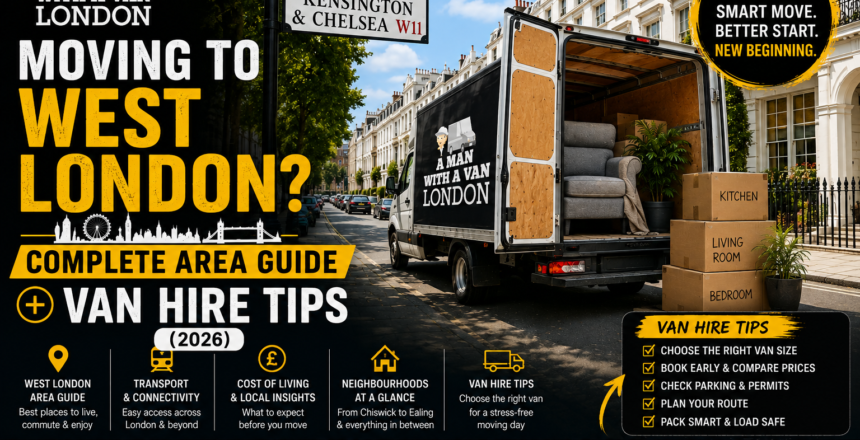
West London covers more ground and more variety than most people expect. From the glass towers of Canary Wharf’s western counterpart in Hammersmith to the quiet residential streets of Twickenham, from the markets and mansion blocks of Notting Hill to the affordable semi-detacheds of Southall, West London is not one place. It is dozens of distinct communities that happen to share a postcode direction.
If you are thinking of moving to West London, the most important decision is which part. This guide covers every major area in detail, followed by the practical van hire and parking tips that make West London moves different from the rest of the city.
Is West London Right for You?
West London has something genuinely rare in London a full spectrum from ultra-expensive to genuinely affordable, within the same postcode direction.
West London suits you if:
- You want character, green space, and good schools alongside Central London access
- You are moving for work in the media, aviation (Heathrow), or finance (Canary Wharf via Elizabeth Line)
- You want the best value per square foot in Inner London — Ealing and Acton offer this
- You are a family wanting outdoor space — Richmond Park, Kew Gardens, and the Thames towpath are all here
West London may not suit you if:
- You need quick access to the Northern or Victoria lines — West London’s tube network is patchy in places
- You are on a very tight budget and need to stay under £1,200/month — inner West London is expensive
- You want a flat, walkable neighbourhood — West London is spread out and often car-friendly rather than pedestrian-focused
West London Neighbourhood Guide – Area by Area
Hammersmith
The vibe: Hammersmith is West London’s business hub — a mix of media companies (Westfield, Sky, Disney all have offices nearby), young professionals, and long-term residents who remember when it was an industrial river town. The riverside pubs and the Lyric Theatre give it a genuine cultural life that many outer West London areas lack.
Housing stock: A mix of Victorian terraces, 1960s–80s purpose-built flats, and modern riverside developments. The area directly around Hammersmith Broadway is noisy and busy. The quieter streets of Brook Green just behind it are a world away in feel.
Average rent (2026): 1-bed flat £1,700–£2,100/month. Victorian house from £2,200/month.
Transport: Piccadilly Line, District Line, Hammersmith & City Line, multiple buses. One of West London’s best-connected areas.
Parking note: The gyratory system around Hammersmith Broadway is one of the more confusing in London for van drivers. We route around it rather than through it. CPZ operates across most residential streets apply to LBH&F for a suspension permit at least 2 weeks before moving day.
Best for: Young professionals, media workers, anyone wanting Inner West London at a slightly lower price than Kensington.
Notting Hill & Ladbroke Grove
The vibe: Notting Hill’s reputation precedes it and lives up to it. The streets around Portobello Road and Holland Park are among the most beautiful in London, lined with pastel-painted terraces and independent shops. Ladbroke Grove, directly north, is grittier and more affordable, with the Trellick Tower providing one of London’s most iconic brutalist landmarks.
Housing stock: Predominantly Victorian and Edwardian terraces, many divided into large flats. The Ladbroke Estate in particular has some of the largest Victorian houses in London. Mansion blocks are common near Holland Park.
Average rent (2026): 1-bed flat £1,800–£2,400/month. The cheapest flats are north of the Westway (A40), not south of it.
Transport: Central Line (Notting Hill Gate, Ladbroke Grove), District Line (Notting Hill Gate).
Parking note: Portobello Road Market operates on Saturdays. The streets around it are essentially inaccessible from morning until mid-afternoon. We always book early morning starts for Notting Hill Saturday moves. CPZ operates throughout apply to RBKC for a suspension permit.
Best for: Those who want the most beautiful streets in West London and are willing to pay for them. Also good for families — Holland Park is one of London’s best parks.
Kensington & Earl’s Court
The vibe: Kensington is one of London’s most affluent areas. South Kensington in particular has a high concentration of international residents (French, Italian, Brazilian communities all have long roots here). Earl’s Court has historically been more transient and affordable but has been gentrifying steadily for a decade.
Housing stock: Large period houses and mansion flats in South Kensington. More compact Victorian terraces in Earl’s Court. Many buildings have no lift and challenging staircase access.
Average rent (2026): 1-bed flat £1,900–£2,600/month in South Kensington. Earl’s Court from £1,600/month.
Transport: Piccadilly Line and District Line (South Kensington, Earl’s Court). Close to the Congestion Charge zone.
Parking note: RBKC operates the strictest parking regime in London. Resident permit zones cover virtually every street. Apply for a suspension permit from RBKC at least 2 weeks before moving day. Do not assume you can find a space. The Congestion Charge applies to routes through this area into Central London.
Best for: International residents, professionals working in Central London, those who can afford the premium for one of London’s most prestigious postcodes.
Shepherd’s Bush & White City
The vibe: Shepherd’s Bush has genuinely diverse character Westfield London (one of Europe’s largest shopping centres), a busy market, the O2 Shepherd’s Bush Empire, and residential streets that mix Victorian housing with post-war estates. White City is being rapidly transformed by the BBC Television Centre development into a creative and residential hub.
Housing stock: Victorian terraces, 20th-century estates, and a growing number of new-build developments around Television Centre and Wood Lane. Good value relative to Notting Hill and Kensington.
Average rent (2026): 1-bed flat £1,500–£1,900/month. Improving rapidly as White City develops.
Transport: Central Line (Shepherd’s Bush, White City, Wood Lane). District Line (Shepherd’s Bush Market). Excellent Westfield parking for visitors.
Parking note: Streets around Shepherd’s Bush Green are particularly restricted. CPZ applies throughout apply to H&F Council.
Best for: Creatives, media workers (BBC, Sky nearby), younger professionals who want character and value.
Chiswick
The vibe: Chiswick is where West London gets genuinely suburban in the best sense tree-lined streets, independent restaurants along Chiswick High Road, the Thames towpath, and Kew Gardens within cycling distance. It draws families who want a proper neighbourhood rather than a city centre lifestyle.
Housing stock: Predominantly Victorian and Edwardian terraces and semis, many with gardens. Chiswick has some of the most attractive residential streets in West London. Moving into Victorian Chiswick requires care original character means narrow doorways and awkward stairwells in some properties.
Average rent (2026): 1-bed flat £1,600–£2,000/month. Family houses from £2,400/month.
Transport: District Line (Chiswick Park, Gunnersbury), Overground (Chiswick). Less direct than inner West London.
Parking note: Residents-only parking covers most of Chiswick apply to Hounslow Council. The A4 runs through the area and can cause congestion on weekday mornings.
Best for: Families, established professionals, anyone wanting village-feel London at a premium.
Ealing & Acton
The vibe: Ealing is one of the Elizabeth Line’s biggest beneficiaries journey times to Paddington and the City are now fast enough to make it genuinely competitive with much more expensive areas. Acton sits between Ealing and Shepherd’s Bush and offers similar value with a slightly more urban feel.
Housing stock: Mostly Edwardian and inter-war semis and terraces, with some modern flat developments around Ealing Broadway. Good garden space relative to price. Moving into Ealing semis is generally straightforward good road access and manageable staircases.
Average rent (2026): 1-bed flat £1,300–£1,700/month. 2-bed houses from £1,600–£2,000/month.
Transport: Elizabeth Line and Central Line (Ealing Broadway), District Line. Paddington in under 10 minutes. Heathrow in 25 minutes.
Parking note: CPZ operates in central Ealing around the Broadway. Outer streets are generally easier for parking than inner West London.
Best for: Families, commuters, first-time buyers looking for space and value. One of the best-value areas in West London right now.
Southall
The vibe: Southall is one of London’s most distinctive and vibrant communities – the centre of British South Asian culture in London, with extraordinary food, shopping, and community life. It has historically been overlooked by people moving to West London, which means property prices remain significantly lower than comparable transport connections would suggest elsewhere.
Housing stock: A mix of Edwardian terraces, 1950s–70s semis, and some new builds. Gardens are common. Good value for money.
Average rent (2026): 1-bed flat from £1,000–£1,300/month. 2-bed houses from £1,200–£1,600/month.
Transport: Elizabeth Line (Southall) – Paddington in 12 minutes. Heathrow in 15 minutes. An exceptional transport connection for the price.
Best for: Anyone who wants Elizabeth Line access at the lowest possible price. Particularly good for Heathrow workers.
Uxbridge
The vibe: Uxbridge is at the far western edge of Greater London suburban, spacious, and significantly more affordable than inner West London. Brunel University is here, giving it a student population that adds some energy to what is otherwise a quiet commuter town.
Housing stock: Detached and semi-detached houses dominate, with flat developments near the High Street and town centre. Some of the largest properties available in the Greater London area at London prices.
Average rent (2026): 1-bed flat from £900–£1,200/month. 2-bed houses from £1,100–£1,500/month.
Transport: Metropolitan Line and Piccadilly Line (Uxbridge). Central London in 45–55 minutes. Heathrow in 15 minutes.
Best for: Families wanting maximum space, Heathrow workers, students at Brunel University.
Practical Van Hire Tips for Moving to West London
After 18+ years of man and van West London moves, here is what actually makes a difference on moving day.
The Congestion Charge Catches People Out
The CC zone’s western boundary runs through parts of Kensington, Chelsea, and the roads leading into Central London. If you are moving from South Kensington, Earl’s Court, or parts of Hammersmith, your route may pass through the zone and the van will incur an £18 daily charge.
A professional man with a van in London checks your specific route before confirming your quote and tells you upfront. Never book a service that quotes without asking your postcode.
RBKC Parking – Book Early, Book the Right Council
Moving in Kensington or Chelsea means dealing with the Royal Borough of Kensington & Chelsea. The most restrictive parking authority in London. A suspension permit is essential for almost any move in this area.
Apply at least 3 weeks before your moving date for Kensington and Chelsea are slightly earlier than the standard 2-week recommendation we give for other London boroughs. Applications can take longer to process and the Council can be strict on short-notice requests.
Portobello Road Saturdays – Avoid or Start Very Early
If you are moving anywhere near Notting Hill or Ladbroke Grove on a Saturday, the Portobello Road Market makes most streets in the area difficult or impossible to navigate from around 9am until mid-afternoon. Either book a 7am start or plan a weekday move for this area.
Victorian West London – Measure Everything
Chiswick, Notting Hill, Hammersmith, and large parts of Ealing have Victorian housing stock. Narrow hallways, original staircases with tight turns at the top, and doorways that were built before modern furniture existed are all common. Measure your large furniture particularly sofas, wardrobes, and bed frames against the doorway widths and stairwell clearances at your new property before moving day.
Elizabeth Line Changes the Value Equation
If you are comparing West London options, factor in the Elizabeth Line properly. Ealing Broadway, Acton Main Line, Southall, Hayes and Harlington all now have fast direct access to Paddington, the City, and Heathrow. The price difference between these areas and comparable inner West London postcodes is significant and the transport difference is now minimal.
How Much Does a Man and Van Cost for a West London Move?
Here is what to budget for a man and van West London move in 2026:
| Move Type | Van Size | Typical Duration | From |
|---|---|---|---|
| Studio / single room | Small van | 2 hrs (minimum) | £100 |
| 1-bedroom flat | Large van | 3–4 hrs | £195–£260 |
| 2-bedroom flat or house | Luton van | 4–5 hrs | £300–£375 |
| 3-bedroom house | Luton + 3 movers | 5–7 hrs | £375–£525 |
A 2-hour minimum applies to all bookings. ULEZ is included with no surcharge. Congestion Charge (£18) confirmed for your specific route before the move begins.
See our full man and van London prices for a complete breakdown by van size.
West London Moving Checklist
- Apply for a parking suspension permit at least 2 weeks before (3 weeks for RBKC)
- Confirm goods lift access for any new-build or managed apartment building
- Check Portobello Road Market dates if moving near Notting Hill on a Saturday
- Confirm your route includes or avoids the Congestion Charge zone
- Measure large furniture against doorways and stairwells – Victorian West London is unforgiving
- Label every box by room – your movers place everything correctly without you directing each box
- Set aside a first-night bag – keep it with you, not on the van
- Check parking at the new address too – not just your old one
Frequently Asked Questions
How much does a man and van cost in West London?
Prices start from £50/hr with a 2-hour minimum (from £100). A typical 1-bed flat move costs £195–£260. Congestion Charge may apply depending on your route. See full man and van London prices.
Which West London area offers the best value?
Ealing, Acton, and Southall consistently offer the best value in West London relative to their transport connections. All three have Elizabeth Line access which has significantly improved their commute times to Central London and the City.
Is West London inside the ULEZ zone?
Yes, all of West London, including outer areas like Uxbridge and Hayes, is within the Ultra Low Emission Zone. Our entire fleet is ULEZ compliant, no surcharge on any booking.
Do I need a parking permit for a West London move?
In most areas, yes. CPZ restrictions apply across most of inner West London. RBKC (Kensington and Chelsea) requires the most lead time apply 3 weeks before. All other West London boroughs recommend 2 weeks minimum.
Do you cover all of West London?
Yes. Our man and van West London service covers every West London borough and postcode from Kensington and Notting Hill to Ealing, Southall, Uxbridge, and everywhere in between. Available 24 hours a day, 7 days a week.
Planning a move elsewhere in London? See our guides to North London removals, East London removals, South London removals, and house removals across London.
Ready to book? Get an instant quote at amanwithavanlondon.co.uk/book-online or call 07702894895 — available 24/7.